


Comprehensive Motor Insurance Policy in Nigeria is a type of motor insurance policy that covers accidental damage, theft, fire, third-party bodily injury, and third-party property damage under a single contract. The National Insurance Commission (NAICOM) licenses and supervises all motor insurance underwriters operating in Nigeria under the Insurance Act 2003 and the Nigerian Insurance Industry Reform Act (NIIRA) 2025. This article covers what comprehensive motor insurance includes, how it differs from third-party cover, what it costs, the standard exclusions to watch for, and how claims are processed.
What Is Comprehensive Motor Insurance in Nigeria?
Comprehensive motor insurance in Nigeria is the broadest class of motor vehicle insurance available to private and commercial vehicle owners. It combines own-damage cover with third-party liability cover in a single policy document.
A Comprehensive Motor Insurance Policy in Nigeria typically covers:
-
- Accidental damage to the insured vehicle, including collision, overturning, and impact
-
- Fire and explosion damage to the insured vehicle
-
- Theft of the insured vehicle or attempted theft resulting in damage
-
- Third-party bodily injury liability, including death
-
- Third-party property damage liability up to the policy limit
-
- Flood and storm damage, subject to policy terms and exclusions
-
- Windscreen and glass breakage, in some policy variants
Optional extensions available from most underwriters include roadside assistance, personal accident cover for the driver, and medical expenses for occupants.
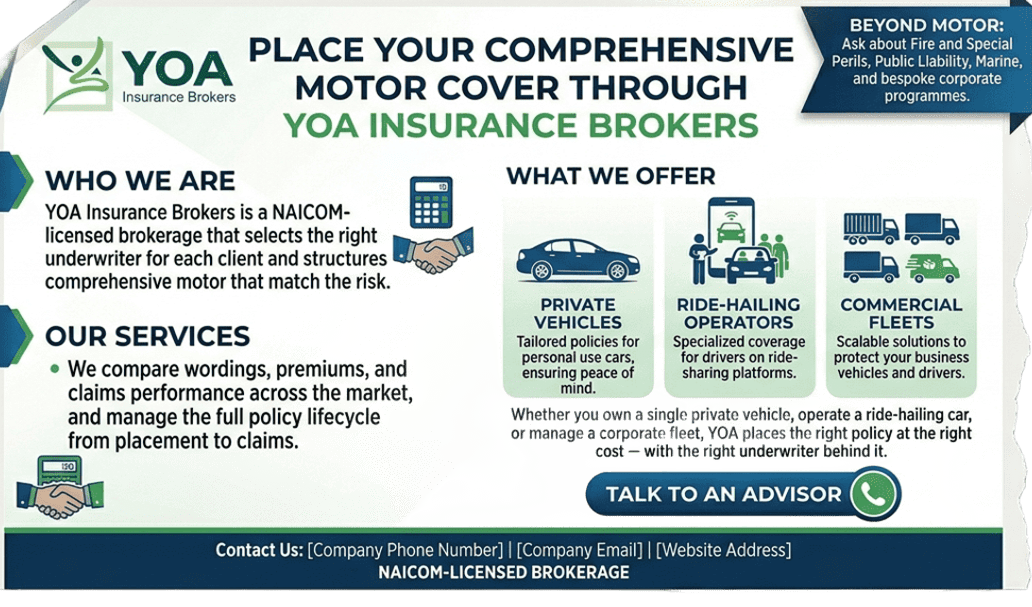
Policy wordings are developed by insurers subject to NAICOM regulations. Coverage scope, extensions, and exclusions vary across underwriters, and policy schedules should be reviewed carefully to confirm specific inclusions before purchase. A licensed insurance broker like YOA Insurance Broker, can compare wordings across the market and recommend an underwriter whose terms best fit the risk profile of the insured.
Third-Party vs Comprehensive Insurance Nigeria
The primary distinction between third-party and comprehensive motor insurance in Nigeria is the scope of own-damage coverage.
Third-Party Motor Insurance is the minimum compulsory cover mandated by the Insurance Act 2003. It covers only liability to third parties — bodily injury, death, and property damage caused by the insured vehicle. Under prevailing regulations, the statutory third-party property damage limit for private vehicle is ₦3 million per incident, with insurers free to extend cover above that limit at additional premium, while commercial vehicle is ₦5 million. Third-party cover provides no protection for damage to the policyholder’s own vehicle, regardless of cause.
Comprehensive Motor Insurance covers both third-party liability and damage to the insured vehicle itself. It activates in the event of an accident, theft, fire, or natural peril, making it the appropriate policy for vehicles with significant market value or those subject to financing arrangements.
| TYPE OF INSURANCE | SCOPE OF COVERAGE | QUOTE REQUIREMENT |
|---|---|---|
| Comprehensive Motor Insurance |
1. Accident loss or damage to the vehicle Additional benefits include: |
1. Sum Insured value of the truck (head and tail) 2. Vehicle Licence & Particulars |
| Third-party Fire & Theft Motor Insurance | 1. Fire damage/loss 2. Theft or attempted theft of Insured vehicle. 3. Third-party property damage: ₦5,000,000.00 . 4. Third-party bodily injury or death (unlimited but reasonable). 5. Ecowas Jurisdiction Cover (Third Party Property Damage). |
1. Sum Insured value of the truck (head and tail) 2. Vehicle Licence & Particulars |
| Third-party Only Motor Insurance | 1. Third-Party Property Damage: ₦5,000,000.00 2. Third party bodily injury or death (Unlimited but reasonable) 3. Ecowas Jurisdiction Cover (Third Party Property Damage) |
1. Sum Insured value of the truck (head and tail) 2. Vehicle Licence & Particulars |
The NIIRA 2025 strengthened enforcement of compulsory third-party motor insurance across Nigeria and expanded the scope of the ECOWAS Brown Card, which extends third-party cover across all ECOWAS member states. Comprehensive policies automatically satisfy the compulsory insurance requirement.
Vehicles subject to a hire-purchase agreement or bank financing typically require comprehensive vehicle coverage as a condition of the financing contract. Lenders require this because the vehicle serves as collateral, and third-party cover alone does not protect the lender’s interest in the asset.
Cost of Motor Insurance in Nigeria
The cost of comprehensive motor insurance in Nigeria is calculated as a percentage of the vehicle’s current market value, adjusted for the vehicle’s age, make, use type, and the insured’s claims history.
NAICOM does not prescribe a fixed tariff rate for comprehensive motor insurance, but in practice standard private vehicles are rated at approximately 5% of the sum insured. This rate applies broadly across the market and is largely consistent across underwriters, vehicle make, and individual claims history within the private motor segment. Commercial use, ride-hailing, high-value imports, and significant adverse claims experience may attract loading above the standard rate.
Key premium rating factors include:
-
- Vehicle value (sum insured): Higher-value vehicles attract larger absolute premiums.
-
- Vehicle make and model: Import vehicles, SUVs, and high-performance models may attract loading due to elevated repair costs.
-
- Vehicle age: Older vehicles may attract loading or be subject to depreciation clauses that affect claims settlement.
-
- Vehicle use: Private use policies are rated lower than commercial or hire-purchase use. Ride-hailing use (Uber, Bolt) is a distinct risk category that requires declaration at inception.
-
- Driver profile: Some insurers apply age and experience-based rating adjustments.
-
- Excess (deductible): A higher policy excess reduces the premium but increases the policyholder’s out-of-pocket cost at the point of a claim.
-
- Claims history: Vehicles or policyholders with prior accident claims may attract premium loading on renewal.
A Note on Vehicle Valuation
The sum insured stated on the policy should reflect the vehicle’s fair market value at policy inception. Over-insuring a vehicle does not increase the eventual claim payout — insurers settle own-damage claims based on the market value at the time of loss or the insured value, whichever is lower, subject to policy terms. Conversely, under-insurance can result in a proportional reduction in any claim payment under the principle of average. Establishing the right sum insured at inception, and reviewing it at each renewal, protects the policyholder on both sides.
A licensed broker can obtain and compare quotes from multiple underwriters and help establish a fair sum insured for a given risk profile.
Selecting a Motor Insurance Underwriter in Nigeria: What to Evaluate
No single insurer can be objectively designated as the leading motor insurance provider in Nigeria. NAICOM licenses all operating motor insurers, and selection should be based on verifiable performance criteria rather than marketing claims. The criteria below are the same ones a licensed insurance broker applies when placing motor risks on behalf of clients.
– Financial Strength and NAICOM Compliance
All motor insurance companies in Nigeria must meet NAICOM’s minimum capital requirements and submit audited financials annually. The NIIRA 2025 revised minimum paid-up capital for general insurers. Policyholders should confirm that their chosen insurer holds a valid NAICOM licence, which can be verified at naicom.gov.ng.
– Claims Settlement Record
The claims management process is the most material performance indicator for any motor insurer. Useful metrics to request from a broker before placing cover include average claims settlement turnaround time, claims approval ratio, and whether the insurer operates a direct repair network.
– Network of Approved Repairers
Comprehensive vehicle coverage typically requires repairs to be carried out at an insurer-approved panel of garages. The breadth and quality of this repair network directly affects the speed and cost of claims resolution.
– Policy Wording and Exclusions
Standard exclusions in Nigerian comprehensive motor insurance policies include:
-
- Damage occurring while the vehicle is being driven by an unlicensed driver
-
- Damage occurring while the driver is under the influence of alcohol or drugs
-
- Damage caused while the vehicle is used outside the declared use category
-
- Use of the vehicle outside the geographical limits stated in the policy schedule
-
- Mechanical or electrical breakdown not caused by an insured peril
-
- Wear and tear, and gradually operating causes
-
- Consequential loss (such as loss of income or the cost of hiring a replacement vehicle)
-
- Confiscation by government or regulatory authorities
Reviewing the policy schedule and certificate of insurance before purchase confirms that coverage terms match the intended use of the vehicle.
– The Broker’s Role in Underwriter Selection
Selecting the right underwriter is a technical exercise that combines financial analysis, claims data, wording review, and direct market experience of how an insurer behaves at the point of loss. A NAICOM-licensed broker discharges this responsibility on behalf of clients across private, commercial, and fleet motor risks, and applies the same approach to adjacent covers such as fire and special perils insurance and broader commercial lines. Engaging a regulated broker places the burden of comparison, placement, and ongoing policy management with an intermediary whose duty of care is owed to the insured.
Comprehensive Motor Insurance Policy: Documentation Requirements
Purchasing a comprehensive motor insurance policy in Nigeria requires the submission of specific documents to the underwriter or broker.
Standard documentation includes:
-
- Valid means of identification (national ID, international passport, or driver’s licence)
-
- Vehicle registration documents (proof of ownership)
-
- Vehicle valuation or purchase receipt (to establish the insured value)
-
- Completed proposal form (disclosing vehicle use, driver information, and claims history)
-
- Payment confirmation of premium
Upon policy issuance, the insured receives:
-
- Motor Insurance Certificate: The statutory document required for vehicle registration and road use in Nigeria. It is issued by the insurer and linked to the Nigerian Insurance Industry Database (NIID), maintained by the Nigerian Insurers Association (NIA) at askniid.org. The NIID allows law enforcement, the FRSC, and the Vehicle Registration System to verify motor insurance certificates electronically in real time. With NIID verification widely available, carrying a physical copy of the certificate remains useful as a fallback, but electronic verification is increasingly the primary means of confirming cover at the roadside.
-
- Policy Schedule: Sets out the specific terms, sum insured, premium, excess, and coverage period.
-
- Policy Document: The full contract terms, including all conditions, warranties, and exclusions.
NAICOM prohibits the use of fake motor insurance certificates and has introduced criminal penalties for certificate fraud under the NIIRA 2025.
How the Claims Management Process Works
The claims management process for comprehensive motor insurance in Nigeria follows a defined sequence of steps that the policyholder must initiate promptly after a loss.
Step 1 — Notification
The policyholder must notify the insurer or broker of the loss within the timeframe specified in the policy (typically 24 to 72 hours for accidents, and immediately for theft). Late notification can prejudice the claim.
Step 2 — Police Report
For accidents involving third-party injury or significant property damage, and for all theft claims, a police report from the nearest Nigerian Police Force station is required. This document is a standard underwriting requirement across the market.
Step 3 — Claims Documentation
The insurer or broker provides a claims form that must be completed and submitted alongside:
-
- Police report (where applicable)
-
- Photographs of the damaged vehicle
-
- Estimate of repair costs from an approved repairer
-
- Driver’s licence of the driver at the time of the loss
-
- Copy of the motor insurance certificate and policy schedule
Step 4 — Assessment
The insurer assesses the claim against the policy terms and supporting documentation. Minor own-damage claims — for example, low-value glass breakage or small panel damage — are typically handled internally by the insurer’s claims department. Larger, contested, or total-loss claims are referred to an independent loss adjuster, who inspects the damaged vehicle and validates the repair estimate. For total-loss claims (where repair costs exceed a defined percentage of the insured value), the adjuster also determines the market value of the vehicle at the time of loss.
Step 5 — Excess and Settlement
Most comprehensive motor policies in Nigeria carry a policy excess — the portion of each own-damage claim that the insured is required to bear before the insurer pays. The excess is expressed as either a percentage of the claim amount or a fixed naira sum, and is set out in the policy schedule. Confirming the applicable excess before authorising repairs avoids surprises at settlement.
Once liability is established and documentation is complete, the insurer settles the claim either by direct repair authorisation at an approved garage or by cash payment to the policyholder’s nominated bank account. Actual settlement turnaround varies in practice and depends on the completeness of documentation, the loss adjuster’s report (where one is appointed), and the determination of liability between the parties involved. NAICOM encourages prompt settlement, and policyholders who experience undue delays may file a formal complaint through the NAICOM Consumer Portal at naicom.gov.ng.
Motor Insurance for Ride-Hailing and Fleet Operators
Ride-hailing drivers operating on platforms such as Uber and Bolt in Nigeria must declare their commercial use at policy inception. Standard private-use comprehensive motor insurance policies contain a use-of-vehicle warranty that excludes cover while the vehicle is being used for hire or reward.
A ride-hailing or hire-vehicle endorsement upgrades the policy to cover commercial use. This endorsement attracts an additional premium loading and must be confirmed in the policy schedule.
Fleet operators — including logistics companies, corporate transport providers, and vehicle leasing businesses — access motor insurance through fleet policies, which cover multiple vehicles under a single policy contract. Fleet policies are negotiated on a per-vehicle basis and typically attract lower per-unit premiums than individual policies due to volume and risk pooling. Fleet motor insurance is best placed through a NAICOM-licensed insurance broker, who can negotiate fleet-rated terms across the market.
Conclusion
Comprehensive motor insurance in Nigeria provides the broadest available motor vehicle coverage, encompassing accidental damage, theft, fire, and third-party liability under a single policy regulated by the National Insurance Commission. Premiums for standard private vehicles are typically rated at around 5% of the sum insured, with loading applied for commercial use, adverse claims history, or higher-risk vehicle profiles. Policy authenticity is verifiable through the NIID at askniid.org, and prompt notification, complete documentation, and clarity on policy excess remain the most important factors in efficient claims settlement.