

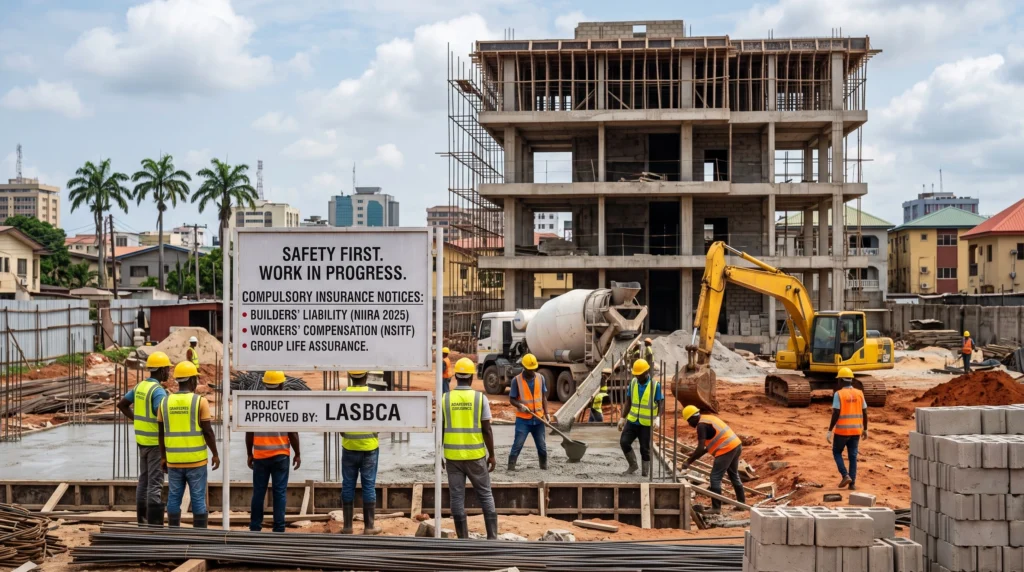
Insurance for construction companies in Nigeria is governed by the Nigerian Insurance Industry Reform Act 2025 (NIIRA), the Employee Compensation Act 2010, and the Pension Reform Act 2014. These statutes make several covers compulsory for contractors and property owners, while commercial exposures such as plant damage and design error require additional policies. This article sets out the statutory covers, the core project policies, and the criteria used to select an underwriter.
Key facts about Insurance for Construction Companies in Nigeria (2026):
- Construction and real estate firms in Nigeria need five statutory covers (builders’ liability, occupiers’ liability, group life assurance, employers’ liability, and motor third party) plus commercial covers led by Construction All Risks.
- NIIRA 2025 requires builders’ liability insurance for any building under construction with more than one floor. This lowered the previous two-floor threshold under the repealed Insurance Act 2003.
- Occupiers’ liability insurance is compulsory for all public buildings, including offices, malls, hotels, schools, and hospitals.
- Group life assurance is mandatory at three times annual emolument for employers with three or more employees, under the Pension Reform Act 2014.
- Construction All Risks is the core project policy. The sum insured equals the full contract value.
- Select insurers by NAICOM licence, capital adequacy (life ₦10 billion, non-life ₦15 billion, reinsurance ₦35 billion), and confirmed reinsurance capacity.
What Insurance Do Construction and Real Estate Companies Need?
Construction and real estate companies operating in Nigeria require five statutory covers and three to four commercial covers.
The statutory covers are builders’ liability insurance, occupiers’ liability insurance, group life assurance, employer liability under the Employee Compensation Act 2010, and motor third party insurance. The National Insurance Commission (NAICOM) enforces compliance with each.
The principal commercial covers are Construction All Risks (CAR), Professional Indemnity, contractors’ plant and machinery, and fire and special perils insurance for both completed assets and building under construction. These are not mandated by statute. They address the loss exposures that statutory liability policies exclude.
Compulsory Insurance Under the Nigerian Insurance Industry Reform Act 2025
NIIRA 2025 repealed and replaced the Insurance Act 2003, the Marine Insurance Act, and the Motor Vehicles (Third Party Insurance) Act. It retained the compulsory insurance regime established under Sections 64 and 65 of the repealed Insurance Act 2003 and expanded enforcement powers held by NAICOM.
Builders’ Liability Insurance
Any building under construction with more than two floors must carry builders’ liability insurance. The cover responds to hazards of collapse, fire, earthquake, storm, and flood. It also indemnifies the contractor against liability for bodily injury, death, or property damage suffered by members of the public on or adjacent to the site.
The obligation sits with the owner or developer of the building, not solely with the contractor. Regulatory bodies including the Lagos State Building Control Agency (LASBCA) require evidence of this cover as a condition of construction approval in Lagos State.
Occupiers’ Liability Insurance
Occupiers’ liability insurance is compulsory for public buildings. NIIRA 2025 defines a public building to include tenement houses, hostels, offices, hotels, schools, hospitals, and any building to which members of the public have access.
The policy indemnifies the occupier against liability for death, bodily injury, or property damage caused to users of the premises. Real estate companies that own or manage multi-tenant commercial property carry this obligation across every qualifying asset in the portfolio.
Group Life Assurance
Section 4(5) of the Pension Reform Act 2014 requires every employer with three or more employees to maintain group life assurance for a minimum of three times each employee’s annual total emolument. The National Pension Commission (PenCom) supervises compliance. Construction firms with fluctuating site headcounts must reconcile the insured schedule at each renewal.
Employers’ Liability Insurance
Employers’ liability insurance covers a contractor’s legal liability for bodily injury, occupational disease, or death sustained by its own workers in the course of employment. Construction sites carry high exposure to injury, so the policy responds to compensation claims and the associated legal costs brought by employees or their dependants.
The cover indemnifies the contractor for both common law and statutory compensation claim from workers. It complements the mandatory employee compensation scheme administered by the Nigeria Social Insurance Trust Fund (NSITF).
Motor Third Party Insurance
Every vehicle operated on Nigerian roads requires third party motor insurance. NIIRA 2025 raised the minimum third party property damage limit from ₦1 million to ₦5 million. Construction fleets including tippers, concrete mixers, and haulage units fall within scope.
Construction All Risks Insurance: The Core Project Policy
Construction All Risks insurance is the primary policy for construction projects in Nigeria. It is a composite policy with two sections.
Section one covers physical loss or damage to the contract works, materials on site, and temporary works. Insured perils typically include fire, flood, storm, theft, collapse, subsidence, and faulty workmanship, subject to policy exclusions. Section two covers third party liability arising from the execution of the works.
The sum insured is set at the full contract value, including materials supplied free of charge by the employer. Policy periods run from commencement of works to practical completion, with a maintenance or defects liability extension of 12 to 24 months.
Erection All Risks (EAR) is the equivalent cover for projects dominated by plant installation and mechanical erection rather than civil works. Contractors delivering both scopes commonly place a combined CAR/EAR programme.
Real Estate Insurance for Property Developers and Managers
Real estate insurance in Nigeria addresses asset damage, occupier liability, and advisory error. Three policies form the standard programme.
Fire and Special Perils Insurance
This policy indemnifies the owner for damage to completed buildings, fixtures, and contents caused by fire, lightning, explosion, flood, storm, and impact. Extensions cover loss of rent following an insured event. Lenders financing commercial property in Nigeria typically require the policy to be noted in their interest.
Public Liability Insurance
Public liability insurance covers legal liability to third parties for injury or property damage occurring on the insured premises. It operates alongside compulsory occupiers’ liability cover and typically carries a higher indemnity limit.
Professional Indemnity Insurance
Professional indemnity insurance covers claims arising from negligent design, specification, or advice. It applies to design-and-build contractors and to consultants registered with the Council for the Regulation of Engineering in Nigeria (COREN) and the Nigerian Institute of Architects. The policy is written on a claims-made basis, so continuous cover must be maintained after project completion.
Additional Covers for Construction Risk Transfer
Four further policies address exposures excluded from CAR programmes.
Contractors’ plant and machinery insurance covers owned and hired equipment against damage, overturning, and theft, including cover in transit between sites. Marine cargo insurance covers imported equipment and materials; NIIRA 2025 requires goods imported into Nigeria to be insured with a locally licensed insurer. Fidelity guarantee insurance covers financial loss from employee dishonesty. Machinery breakdown insurance covers plant failure from mechanical causes.
How to Select an Insurance Provider
Verify the licence first. NAICOM publishes the register of licensed insurers and reinsurers, and the Nigerian Council of Registered Insurance Brokers (NCRIB) registers brokers. Placement with an unlicensed entity leaves the policyholder without regulatory recourse.
Assess claims-paying capacity next. The Nigerian Insurers Association (NIA) publishes industry claims data, and NIIRA 2025 raised minimum capital requirements to ₦10 billion for life insurers, ₦15 billion for non-life insurers, and ₦35 billion for reinsurers. NAICOM confirmed that 43 insurers and reinsurers met these thresholds in August 2026. Large contract values also require confirmation of reinsurance arrangements, commonly placed with Africa Re or comparable treaty markets.
Registered brokers add value on programme design, wording negotiation, and claims advocacy. Broker remuneration is paid by the insurer as commission, so the placement route does not increase the premium paid by the client. YOA Insurance Brokers is a NAICOM-licensed brokerage that places construction, engineering, and real estate risks in the Nigerian market.
What Determines Construction Insurance Premiums in Nigeria
Premium rating for construction insurance reflects five variables: contract value, project duration, structural height and complexity, site location and exposure to flood, and the contractor’s claims history.
Projects in flood-prone areas of Lagos, Bayelsa, and Kogi States attract loading on the storm and flood peril. Deductible selection also affects rating. Higher voluntary excesses reduce premium but transfer more attritional loss back to the contractor.
Conclusion
Insurance for construction companies in Nigeria combines statutory covers mandated by NIIRA 2025, the Pension Reform Act 2014, and the Employee Compensation Act 2010 with commercial policies including Construction All Risks, professional indemnity, and plant and machinery cover. Compulsory builders’ liability and occupiers’ liability insurance apply to buildings above two floors and to public buildings respectively. Selection of an insurer should be based on NAICOM licensing status, capital adequacy under NIIRA 2025 thresholds, and confirmed reinsurance capacity for large contract values.
Arrange Cover With YOA Insurance Brokers
YOA Insurance Brokers is a NAICOM-licensed insurance brokerage advising construction firms, engineering contractors, and property developers across Nigeria. The team structures compliant programmes covering builders’ liability, occupiers’ liability, Construction All Risks, professional indemnity, and plant and machinery, and handles placement and claims support on behalf of the client.
Request a free risk advisory review of your project insurance programme, or contact YOA Insurance Brokers to arrange cover.
Frequently Asked Questions
Is builders' liability insurance mandatory for all buildings in Nigeria?
INo. The obligation applies to buildings under construction exceeding two floors. Smaller structures fall outside the statutory requirement, though contractors may still place cover voluntarily.s builders' liability insurance mandatory for all buildings in Nigeria?
Does Construction All Risks insurance cover defective workmanship?
Partially. Most CAR wordings cover resulting damage caused by faulty workmanship but exclude the cost of rectifying the defective work itself. The scope varies by wording and should be confirmed before placement.
Who is responsible for insuring a construction project, the client or the contractor?
The contract determines this. Under standard forms of contract, the contractor usually places CAR insurance in the joint names of the employer and contractor. Builders' liability insurance is a statutory obligation of the building owner.
Are the covers required for real estate companies different from those for contractors?
The programmes overlap but differ in emphasis. Contractors prioritise contract works and site liability during construction. Real estate companies prioritise asset protection, occupiers' liability, and loss of rent across a completed portfolio.