

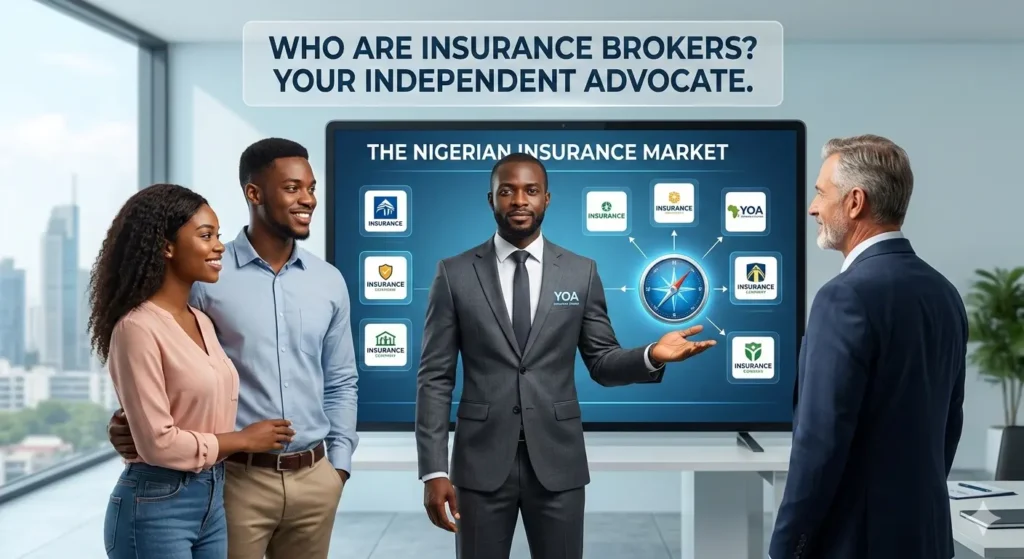
Who are Insurance Brokers?
Insurance brokers in Nigeria are licensed intermediaries regulated by the National Insurance Commission (NAICOM) who represent the interests of insurance buyers, not insurers (Insurance Companies). They assess client risk, search the Nigerian insurance market for suitable coverage, and negotiate policy terms with underwriters on behalf of individuals and businesses. This article explains what insurance brokers do in Nigeria, how they differ from insurance agents, how they are compensated, their licensing requirements under the Nigerian Insurance Industry Reform Act (NIIRA) 2025, and when engaging one provides a measurable advantage.
Who Is an Insurance Broker in Nigeria?
An insurance broker is an independent professional who acts on behalf of the insurance buyer to source, compare, and place insurance coverage across multiple underwriters. NAICOM, the apex regulatory authority for Nigeria’s insurance sector, defines and licenses insurance brokers as intermediaries who advise clients on suitable insurance policies and assist with risk management and claims.
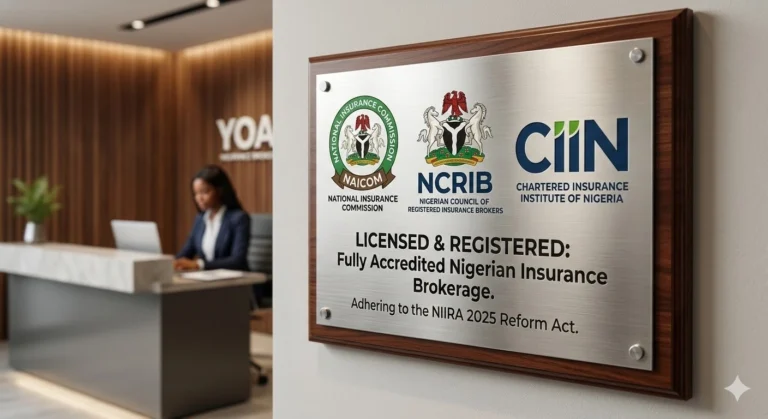
The Nigerian Council of Registered Insurance Brokers (NCRIB), established by Act No. 21 of 2003, is the umbrella professional body for all registered insurance brokers in Nigeria. Every insurance brokerage firm must be registered with the NCRIB and licensed by NAICOM before operating in the Nigerian insurance market. The NCRIB maintains a register of all qualified brokers and enforces professional standards, ethical conduct, and continuing education.
Insurance brokers differ from direct insurance providers in one fundamental way: their contractual obligation runs to the client, not the insurer (insurance company). This distinction creates a duty of care that requires the brokerage professional to act in the client’s best interest when recommending coverage. Unlike insurance agents who are tied to a single insurance company, an insurance broker accesses the entire available market to identify the most suitable policy.
What Do Insurance Brokers Do
Insurance brokers in Nigeria perform five core functions: risk assessment, market search, policy placement, claims Settlement, and ongoing coverage review.
– Risk Assessment
An insurance broker evaluates the client’s specific exposures, including property, liability, professional, and operational risks. This assessment determines the type and amount of coverage required. The Chartered Insurance Institute of Nigeria (CIIN), founded in 1959 and chartered by Act No. 22 of 1993, sets the professional knowledge standards that underpin the risk assessment competence of insurance practitioners across the industry.
– Market Research
The insurance broker accesses multiple underwriters across the Nigerian insurance market to identify policies that match the client’s risk profile. This includes sourcing quotes from insurance companies who are memebers of the Nigerian Insurers Association (NIA), the umbrella trade body for all insurance and reinsurance companies in Nigeria since 1971. For specialised or high-value risks, the insurance broker may access the reinsurance market through entities such as Nigeria Reinsurance Corporation (Nigeria Re) or the African Reinsurance Corporation (Africa Re), both headquartered in Lagos.
– Policy Placement
After comparing quotes, terms, deductible structures, and exclusions, the insurance broker places the policy with the insurer that offers the most appropriate coverage at a competitive premium. Policy placement involves binding coverage and ensuring all documentation complies with NAICOM’s regulatory guidelines.
– Claims Settlement
When a loss occurs, brokers assist clients with claims filing, documentation, and negotiation with the insurer. This function distinguishes brokers from agents, as the broker’s role extends beyond the point of sale. The NIIRA 2025 introduced mandatory timelines for claims processing, strengthening the broker’s ability to hold insurers accountable.
– Continuous Coverage Review
Risk profiles change as businesses grow, acquire assets, or enter new sectors. Coverage specialists conduct periodic reviews to ensure policies remain adequate. NAICOM requires brokers to maintain accurate records of all placements and provide clients with updated advisories as market conditions shift.
Insurance Broker vs Insurance Agent in Nigeria
The distinction between an insurance broker and an insurance agent in Nigeria is structural and regulatory, not merely semantic.
- Representation: An insurance agent represents the insurer and has binding authority to issue policies on the insurer’s behalf. An insurance broker represents the buyer. Under the NIIRA 2025, insurance agents must hold a minimum certificate of proficiency issued by the CIIN, while insurance brokers must meet higher qualification thresholds and be registered with the NCRIB.
- Product Access: Insurance agents sell products from the insurer that appointed them. An insurance consultant operating as a broker accesses the entire Nigerian market, including multiple NIA member companies across life insurance, non-life insurance, and speciality lines such as energy (oil, gas, and power) insurance, marine and aviation insurance, and engineering insurance.
- Regulatory Classification: NAICOM maintains separate licensing categories for insurance agents and brokers. The NIIRA 2025 imposes stricter requirements on brokers, including higher minimum capital, professional indemnity insurance, and mandatory registration with both NAICOM and the NCRIB. Under the Act, operating as an unlicensed insurance intermediary is a criminal offence.
- Scope of Service: Insurance agents facilitate transactions while Insurance brokers provide end-to-end advisory services, including risk assessment, claims advocacy, and coverage optimisation. This broader scope makes the brokerage professional the appropriate intermediary for complex commercial and industrial risks.
How Insurance Brokers in Nigeria are Compensated
Insurance brokers earn income through three primary mechanisms: commissions, brokerage fees, and contingent commissions.
- Commissions. The insurer pays a percentage of the insurance premium to the broker upon policy placement. NAICOM approves the rates of commissions payable across all classes of insurance business in Nigeria. Commission rates vary by product type. Property insurance and casualty insurance commissions differ from those on life insurance, health insurance, or motor vehicle insurance.
- Brokerage Fees. In the commercial insurance market, brokers may charge a separate fee for advisory services, particularly for complex risk placement involving energy insurance, engineering insurance, or large corporate accounts. This fee must be disclosed to the client before engagement.
- Professional Indemnity Requirement. Under the NIIRA 2025, insurance brokers must maintain professional indemnity cover of at least ₦100 million or 50% of annual income, whichever is greater. This is the Nigerian equivalent of Errors and Omissions (E&O) insurance, protecting both the broker and the client against financial loss arising from professional negligence or failure to place adequate coverage.
Licensing and Regulatory Requirements for Insurance Brokers in Nigeria
Operating as an insurance broker in Nigeria requires meeting specific licensing, educational, capital, and professional requirements governed by three entities: NAICOM, the NCRIB, and the CIIN.
– NAICOM Licensing
NAICOM requires corporate entities to obtain a valid insurance broker licence before conducting any brokerage activity. Applicants must be incorporated as a limited liability company in Nigeria under the Companies and Allied Matters Act. The NAICOM Guidelines for Regulation of Insurance Brokers specify that every licensed broker must display its NAICOM licence number, authorisation confirmation footer, and registration category on all correspondence, websites, and publications. NAICOM conducts routine and special investigations to ensure compliance and has powers to suspend, revoke licences, or take over management in cases of serious breach.
– NCRIB Registration
The NCRIB Act No. 21 of 2003 mandates that all insurance broking firms be enrolled with the NCRIB as a condition precedent to receiving a NAICOM licence. The CEO of each brokerage firm must possess the AIIN (Associate of the Insurance Institute of Nigeria), ACII, or an equivalent professional diploma recognised by the CIIN. The CEO must also have a minimum of five years’ practical experience in the insurance industry, with at least two years in a senior management position at a registered broking firm.
– Professional Qualifications
The CIIN administers the professional examination framework for the Nigerian insurance industry. The qualifications pathway includes the Certificate (Cert. CIIN), Diploma (Dip. CIIN), and Associateship (AIIN) designations. The College of Insurance and Financial Management (CIFM), a subsidiary of the CIIN, provides training and education for insurance professionals. Fellowship of the NCRIB (FCIB) represents the highest designation for brokerage professionals and requires a dissertation, project report, and nomination by existing Fellows.
– Capital and Financial Requirements Under NIIRA 2025
The NIIRA 2025, signed into law by President Bola Ahmed Tinubu on 5 August 2025, introduced revised minimum capital requirements for all insurance operators. Brokers must meet prescribed capital thresholds, maintain professional indemnity cover, and are prohibited from holding more than 10% equity in any insurer or loss adjuster to prevent conflicts of interest. Brokers must submit audited financial statements and annual returns to NAICOM. Clients’ funds must be held in separate bank accounts prefixed with “Clients’ Account of…” at deposit money banks insured by the Nigeria Deposit Insurance Corporation (NDIC).

Types of Insurance Brokers in Nigeria
Insurance brokers in Nigeria operate across distinct market segments defined by client type, product specialisation, and market level.
Retail Brokers
Retail brokers work directly with individuals and small to mid-sized businesses in the personal lines and commercial insurance markets. They handle motor vehicle insurance (both third-party and comprehensive), property insurance, health insurance, group life insurance, and general liability coverage. With the NIIRA 2025 strengthening the enforcement of compulsory insurance nationwide, retail brokers play a critical role in connecting everyday Nigerians with valid coverage.
Commercial and Industrial Brokers
Commercial brokers focus on businesses with complex risk profiles across sectors including real estate, healthcare, agriculture, education, energy, FMCG, logistics, and oil and gas. They structure coverage across multiple NIA member companies to build layered programmes that address professional liability, property damage, business interruption, and employee benefits.
Specialty and Energy Brokers
Nigeria’s oil and gas sector generates significant demand for specialist brokerage. Energy insurance brokers advise on upstream, midstream, and downstream risks. NAICOM’s guidelines require that all insurable risks related to oil and gas operations be placed with insurance companies and brokers registered in Nigeria. Placement of insurable risks offshore requires prior written approval from NAICOM, ensuring that local market capacity is fully utilised before any risk is ceded abroad.
Reinsurance Brokers
Reinsurance brokers facilitate transactions between primary insurers and reinsurers. They operate within the reinsurance market, working with entities such as Nigeria Re, Africa Re, and Continental Reinsurance. The NIIRA 2025 revised minimum capital for reinsurers to ₦35 billion, reflecting the critical role reinsurance plays in market stability.

Types of Insurance an Insurance Broker Can Place in Nigeria
Insurance brokers in Nigeria access the full Nigerian insurance market to place coverage across personal, commercial, and industrial insurance lines. The following insurance types represent the core classes that a NAICOM-licensed broker sources, negotiates, and manages on behalf of clients.
Group Life Insurance
Group life insurance provides a lump-sum death benefit to the dependants of employees who die while in active service. Section 9(3) of the Pension Reform Act 2014 mandates that every employer with three or more employees maintain a minimum group life insurance policy equal to three times the employee’s annual total emolument. Insurance brokers structure compliant group life schemes across NIA member underwriters and ensure that policy limits meet statutory minimums as enforced by NAICOM.
Employee Benefits Insurance
Employee benefits insurance is a composite package that combines group life, health insurance, personal accident, and disability cover into a single employer-sponsored programme. Insurance brokers assess the workforce size, salary structure, and industry risk profile of an organisation before designing a benefits package that aligns with both the Employees Compensation Act 2010 and the client’s budget. This class is most relevant to corporate employers, multinationals operating in Nigeria, and growing SMEs seeking to attract and retain staff.
Energy Insurance
Energy insurance covers physical damage and liability risks across the upstream, midstream, and downstream segments of the oil, gas, and power sectors. Cover typically includes property damage to rigs, pipelines, and processing facilities, as well as control of well, blowout, and operators’ extra expense. NAICOM requires that all insurable energy risks in Nigeria be placed with licensed Nigerian underwriters first. Energy insurance brokers with specialist knowledge of this class access both the local Nigerian market and, where local capacity is insufficient, seek NAICOM approval before making offshore placements.
Oil and Gas Insurance
Oil and gas insurance is a sub-class of energy insurance focused specifically on exploration, production, and refining risks. It covers physical loss of or damage to wellheads, platforms, flow lines, and associated infrastructure, as well as pollution liability, maritime employers’ liability, and seepage and contamination. Given the complexity of risk structures in this sector, specialist oil and gas brokers build layered programmes across multiple underwriters to achieve adequate coverage limits. Businesses operating under Department of Petroleum Resources (DPR) or Nigerian Upstream Petroleum Regulatory Commission (NUPRC) licences typically require this class.
Marine Insurance
Marine insurance covers loss of or damage to cargo, vessels, and freight liability during transit by sea, air, road, or rail. The Marine Insurance Act of Nigeria and NAICOM’s guidelines require that all imports into Nigeria be insured with a Nigerian-licensed insurer. Insurance brokers ensure that cargo policies comply with this local content requirement and that coverage terms — including Institute Cargo Clauses A, B, or C — are matched to the nature of the goods and the mode of transit. Marine insurance is critical for importers, exporters, manufacturers, and logistics companies operating across Nigerian ports and inland waterways.
Fire Insurance
Fire insurance covers physical damage to buildings, stock, plant, and machinery caused by fire, lightning, and explosion. It is one of the oldest classes of insurance in Nigeria and forms the foundation of most property insurance programmes. Fire insurance brokers assess the construction type, fire-suppression systems, occupancy risk, and sum insured before placing cover with NIA member underwriters. The class is compulsory for certain categories of buildings under the Insurance Act 2003 and is a prerequisite for mortgage facilities from most Nigerian commercial banks.
Health Insurance
Health insurance covers the cost of medical treatment, hospitalisation, surgery, and pharmaceuticals for insured individuals. The National Health Insurance Authority (NHIA), established by the NHIA Act 2022, regulates health insurance in Nigeria and operates the National Health Insurance Scheme (NHIS). Insurance brokers in the health line source group health plans from NHIA-accredited health maintenance organisations (HMOs) on behalf of employers and match plan tiers — basic, standard, and executive — to the employer’s budget and employee grade levels. Individual health insurance plans are also available for self-employed professionals and proprietors.
Car Insurance (Comprehensive Motor Insurance)
Comprehensive motor insurance covers accidental damage, theft, fire, and third-party liability for private and commercial vehicles. It is the broadest form of motor vehicle insurance available in Nigeria and is placed through NIA member underwriters. Insurance brokers compare premium rates, excess structures, and policy exclusions across multiple carriers before placing cover. The Nigerian Insurance Industry Database (NIID), maintained by the NIA and accessible at askniid.org, provides a real-time verification platform for all motor insurance policies issued in Nigeria.
Third-Party Car Insurance
Third-party motor insurance is the minimum compulsory motor insurance required by law under the Insurance Act 2003 and enforced by the Federal Road Safety Corps (FRSC). It covers bodily injury and property damage caused to third parties by the insured vehicle. The NIIRA 2025 strengthened enforcement of this compulsory class and integrated the ECOWAS Brown Card scheme, extending third-party cover across all ECOWAS member states. Insurance brokers ensure that third-party certificates placed for clients are genuine, NIID-registered, and issued by NAICOM-licensed underwriters.
Property Insurance
Property insurance covers physical damage to buildings, plant, equipment, stock, and contents arising from a range of insured perils including fire, storm, flood, impact, and malicious damage. Brokers structure property insurance programmes for real estate developers, landlords, corporate occupiers, and financial institutions with mortgage-backed assets. Sum insured must reflect current reinstatement value, and brokers advise clients on accurate asset valuation to prevent underinsurance — a common gap that reduces claims settlements proportionally under the average clause.
Travel Insurance
Travel insurance covers medical emergencies, trip cancellation, loss of baggage, and personal accident for individuals travelling domestically and internationally. Insurance brokers source travel policies from NIA member underwriters and specialist travel insurers for individuals, corporate road warriors, and students travelling abroad for education. Some Schengen visa applications require proof of travel insurance as a condition of entry, and brokers facilitate compliant policy issuance in advance of visa submission.
Professional Indemnity Insurance
Professional indemnity insurance covers financial loss caused to a third party by an act, error, or omission committed by a professional in the course of rendering services. It is relevant to lawyers, engineers, architects, accountants, consultants, IT firms, and medical practitioners. Under the NIIRA 2025, insurance brokers are themselves required to maintain a minimum professional indemnity cover of ₦100 million or 50% of annual income, whichever is greater. Brokers who place professional indemnity policies assess the scope of professional services, contract values, and retroactive cover requirements before sourcing terms from underwriters.
Public Liability Insurance
Public liability insurance covers legal liability for bodily injury or property damage caused to members of the public arising from the insured’s business operations or premises. It is one of Nigeria’s compulsory insurance classes. Section 65 of the Insurance Act 2003 mandates public liability coverage for buildings under construction, and NAICOM enforces this requirement for commercial properties accessible to the public. Insurance brokers advise on appropriate indemnity limits based on footfall, the nature of operations, and contractual requirements with landlords or counterparties.
Directors and Officers (D&O) Insurance
Directors and officers insurance covers personal financial liability arising from wrongful acts committed by company directors and senior officers in their management capacity. It protects the personal assets of directors against claims brought by shareholders, regulators, employees, or creditors alleging mismanagement, breach of fiduciary duty, or regulatory non-compliance. D&O insurance is increasingly relevant in Nigeria following the NIIRA 2025, CAC enforcement actions, and the Securities and Exchange Commission’s (SEC) corporate governance guidelines for listed companies. Insurance brokers structure D&O programmes that include Side A (individual protection), Side B (corporate reimbursement), and Side C (entity securities cover) as required.
Workers’ Compensation and Employers’ Liability Insurance
The Employees Compensation Act 2010, administered by the Nigeria Social Insurance Trust Fund (NSITF), requires every employer to provide compensation for work-related injuries, disabilities, and occupational diseases. Insurance brokers advise employers on how private employers’ liability insurance complements statutory NSITF contributions to provide broader financial protection against workplace injury claims. This class is particularly relevant to construction, manufacturing, oil and gas, and logistics businesses with large field workforces.
When to Use an Insurance Broker in Nigeria
Engaging an insurance broker provides the greatest advantage in specific circumstances within the Nigerian market.
- Complex Risk Profiles. Businesses operating across multiple sectors or locations in Nigeria benefit from a risk placement specialist who can structure coverage across several underwriters. This is common in oil and gas, construction, manufacturing, and logistics.
- Market Access. When standard insurance products do not adequately address a client’s needs, a broker accesses the broader market, including specialty carriers and reinsurance arrangements. The Nigerian Insurance Industry Database (NIID), maintained by the NIA, provides verification of all compulsory insurance policies, and brokers use this system to ensure compliance and authenticity of placements.
- Claims History. Clients with adverse claims records or non-standard risk characteristics may find it difficult to obtain coverage through direct channels. An insurance broker with broad market relationships across NIA member companies can identify underwriters willing to write these risks.
- Compulsory Insurance Compliance. Nigeria mandates several compulsory insurance classes, including third-party motor vehicle insurance, occupiers’ liability insurance, builders’ liability insurance, and statutory group life insurance. A broker ensures that coverage meets regulatory minimums and that certificates are properly issued. The ECOWAS Brown Card scheme, now integrated into third-party motor insurance under the NIIRA 2025, extends coverage across all West African countries—a provision that a qualified broker can explain and implement for clients.
- Cost Optimisation. Brokers negotiate premiums, deductible structures, and policy terms across multiple carriers. For commercial clients, this negotiation can yield measurable cost savings compared to single-carrier placements.
Conclusion
Insurance brokers in Nigeria are NAICOM-licensed intermediaries who represent the buyer’s interest across the insurance market. They perform risk assessment, policy placement, claims advocacy, and ongoing coverage management. Their independence from any single insurer, combined with regulatory oversight from NAICOM, professional standards enforced by the NCRIB, and qualification frameworks administered by the CIIN, provides a structural safeguard for clients seeking comprehensive and competitively priced coverage in the Nigerian insurance market.
The enactment of the NIIRA 2025 has strengthened the regulatory environment, introduced higher capital requirements, and mandated faster claims processing—changes that make the role of a qualified insurance broker more relevant than ever for Nigerian individuals and businesses.
Frequently Asked Questions About Insurance Brokers
Q: What is the difference between an insurance broker and an insurance agent?
A: An insurance agent represents one or more specific insurance companies and sells their products. An insurance broker works independently on behalf of the client, comparing options from multiple insurers to find the best fit. Brokers are your advocates; agents represent the insurance companies.
Q: How do insurance brokers get paid in Nigeria?
A: Insurance brokers in Nigeria typically earn commissions from insurance companies when they place policies. These commissions are a percentage of the premium paid. Importantly, working with a broker usually doesn’t cost you extra. The commission is built into the insurance pricing, whether you use a broker or go direct.
Q: Is it mandatory to use an insurance broker in Nigeria?
A: No, it’s not mandatory. You can purchase insurance directly from companies. However, for complex commercial coverage or when you want to compare multiple options, a broker’s expertise can save you money and ensure you get appropriate coverage.
Q: How do I verify if an insurance broker is licensed in Nigeria?
A: You can verify a broker’s license through NAICOM (National Insurance Commission). Licensed brokers should also be able to provide their registration number, which you can cross-check with the regulator. Always work with licensed professionals to ensure accountability.
Q: What types of insurance can brokers help with?
A: Insurance brokers can assist with virtually all types of coverage including motor insurance, property/fire insurance, liability coverage, marine insurance, group health benefits, life insurance, and specialized commercial policies. At YOA Insurance Brokers, we handle personal, business, and corporate insurance needs.
Protect What You’ve Built — Work With a Trusted Insurance Broker
Understanding who insurance brokers are and what they do is the first step toward making informed decisions about your coverage. In Nigeria’s complex insurance landscape, having a knowledgeable advocate on your side isn’t just convenient. It’s essential.
YOA Insurance Brokers has built a reputation as one of Nigeria’s most trusted insurance advisors. We’ve helped hundreds of businesses and individuals protect their assets, manage their risks, and navigate claims successfully. Our commitment to transparency, expertise, and client advocacy sets us apart in the industry.
Don’t wait until you need to file a claim to discover gaps in your coverage. Don’t overpay for policies that don’t truly protect you. Take action today and experience the difference that working with a professional insurance broker can make.
Whether you need motor vehicle insurance, group life cover, professional liability protection, or a comprehensive risk management programme for your business, YOA’s team of certified insurance professionals will structure a solution tailored to your needs.
Get a free insurance consultation today. Contact YOA Insurance Brokers to speak with a certified insurance advisor who will assess your risk profile, compare options across the market, and place the right coverage for you.
Phone: +234 813 607 6588 | Email: info@yoainsurance.com | Website: yoainsurance.com
Connect With YOA Insurance Brokers
Stay updated with the latest insurance news and insights
LinkedIn | Twitter | Facebook | Instagram
One Response